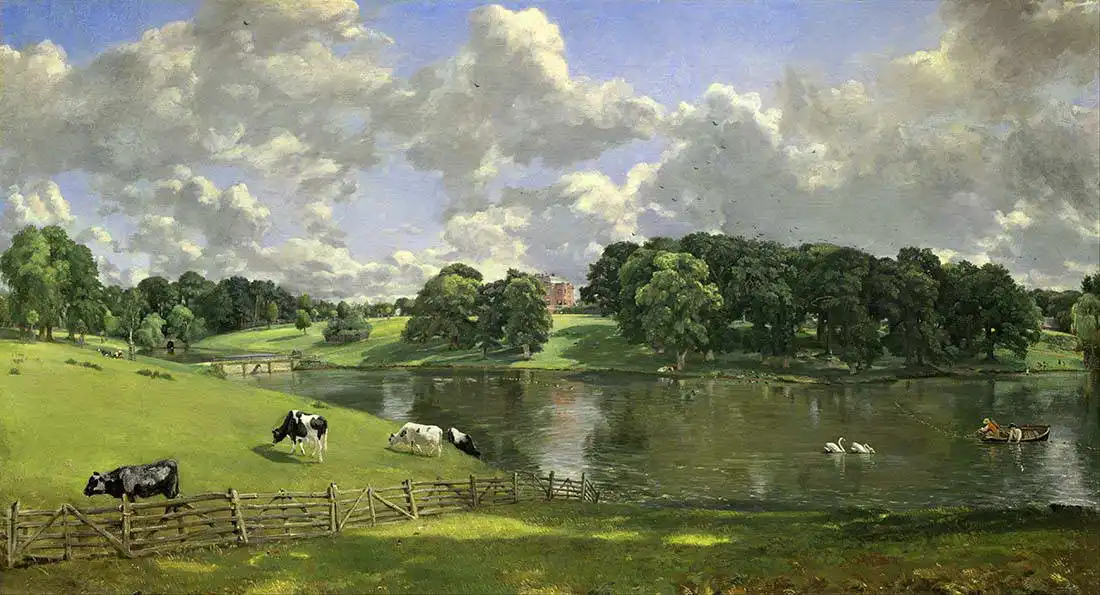
Année de création: 1816 Réalisation: oil on canvas Original enregistré: National Gallery of Art, Washington DC, USA
Texte traduit automatiquement. Veuillez excuser toutes les erreurs!
Cette image a été obligée de peindre sur ordre - qui a naturellement gouverné sa nature de la liberté, car il devait respecter le lieu et la perspective de l'image. Il a capturé la ferme de la famille des rebowch d'Essex. L'affectation a été affichée par les terres familiales en tant que prestation pour le village (donc l'image est également appelée parc). La composition est en quatre quadrants selon les axes verticaux et horizontaux. La partie gauche est légère et ensoleillée, les droits plutôt à l'ombre et avec un ciel plus sombre. Les détails sur l'image, comme le cygne ou le bateau, ne sont pas là-dessus par accident. Ils étaient censés montrer que même un étang privé peut servir une communauté plus large.
Constable a peint le tableau Wivenhoe Park (Essex) en l’an 1816. Les couleurs prédominantes de ce tableau sont vert et son format est long. L'emplacement du tableau original est National Gallery of Art, Washington DC, USA. Nous imprimons une reproduction de ce tableau sur demande - vous pouvez choisir la dimension et la version de la reproduction.
John Constable (1776 - 1837). English painter during Romanticism. He was the son of a miller in Suffolk County and since childhood, he dreamed of becoming one of the best landscape painters of the 19th century. At last, painting really became the sole purpose of his existence. In December 1817, he moved to London with his wife, and there the first of their seven children was born. Children then followed almost invariably each year, but it was very difficult and exhausting to feed such a large family. Landscape painting was not recognized nor a much profitable profession in England in the 19th century. John and Mary worked very hard, which later destroyed their health. Despite this, however, gradually the first significant successes arrived. In 1819, John Constable became an associate member of the Royal Academy of Arts. Two years later, he painted his most famous work Hay Wagon. He exhibited it in London, but he came to fame in 1824 when this image received the gold medal at the Salon in Paris. The local appraisal was full of recognition, but in England his work was viewed with reserve. A year later, although he was accepted as a full member of the Royal Academy of Arts, he exhibited a grim picture, Hadleigh Castle, which expressed grief over the death of his wife. He entrusted their seven children to a nurse, but he still cared for them very well and conscientiously. A very renowned piece is Wivenhoe Park of 1816. In 1833, however, he fell ill and was greatly plagued by old age. To conserve his strength, he painted only less demanding watercolours. Finally, Constable died after a stroke in 1837. His paintings were sold for a small amount auction, and his work achieved recognition many years later.
Comment nous fabriquons nos tableaux (vue détaillée)
Naši zákazníci jsou s námi dlouhodobě spokojeni. Ceníme si toho a děkujeme za Vaši důvěru. Další recenze a detaily hodnocení našich služeb najdete na portálu Heuréka.
Ověřený zákazník: - Jsem nadšená, obraz je krásný a dodání bylo velmi rychlé.
Ověřený zákazník: Rychlá reakce
Rychlé jednáni -
Ověřený zákazník: Rychlé, solidní, kvalitní. - Vše perfektní. Ještě jsme dostali dárek - hezký menší obraz na plátně.


 776 273 496
 Follow us on Instragram