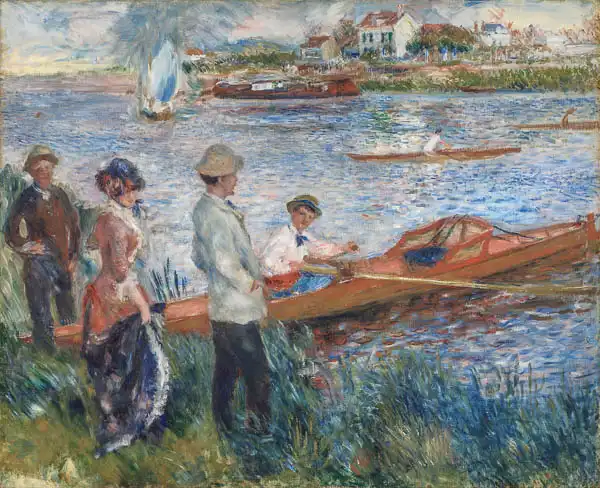
Canottieri a Chatou
ID:
#2148 |
Impressionismo |
PersoneAnno di creazione:
1879Design:
oil on canvasOriginale salvato:
National Gallery of Art, Washington DC, USADimensioni dell'originale:
81.3 x 100.3 Testo tradotto automaticamente. Per favore, scusa tutti gli errori! Con questa tela, rematori nel cottage, Renoir è tornato in uno dei suoi posti preferiti sulla riva della Senna, dove gli piaceva scoprire la bellezza dell'acqua che scorre . L'impressionismo sta cercando di catturare la natura e il mondo ad un certo punto, vivo e bello, che Renoir sta andando molto bene. Il suo lavoro con un pennello non solo cattura la condizione, ma anche il movimento del vento nell'erba e sulla superficie del fiume, l'impressionismo è diventato uno strumento Renoira che è riuscito a adattarsi per soddisfare le sue esigenze. Come molti altri artisti di questa direzione, gli piaceva dipingere il paesaggio da solo, ma con piacere includeva i suoi amici o la sua famiglia, come sta accadendo qui.
Renoir ha dipinto il quadro Canottieri a Chatou nell'anno 1879. I colori predominanti di questo quadro sono rosso e il suo formato è paesaggio. Le dimensioni dell'originale sono 81.3 x 100.3. L'ubicazione del quadro originale è National Gallery of Art, Washington DC, USA. Su richiesta, stampiamo una riproduzione di questo quadro; puoi scegliere le dimensioni e il design della riproduzione.
Pierre Auguste Renoir (1841-1919). One of the greatest French
Impressionists. He painted modestly, humbly studying the works of other painters. His paintings are spontaneous and full of loose, fine brush strokes. Courbet inspired him to depict everyday scenes of ordinary people and Corot influenced Renoir by his love of nature and the use of subtle tones. However, Renoir was most influenced by
Manet, who is known for his colourfulness, small spatial depth and broad brushstrokes.
Renoir’s images are direct, capturing the optimistic atmosphere of Parisian streets and cafes. His nudes are known for their purity, fineness, and the play of light on the human body. Among his best-known works are
The Swing (capturing a beloved courting scene, a festive moment, full of colour and light),
Moulin de la Galette (a symbol of Impressionism showing an open-air summer dance festival),
Luncheon of the Boating Party (an idealized portrait of Renoir’s friends, including his future wife). The image shows the abandon of the upper classes and their leisure time. Among his prized paintings is a series of three paintings
Dance in the Country, Dance in Bougival and
Dance in the City (in which he masterfully painted movement and the atmosphere of dance).


 776 273 496
 Follow us on Instragram